• Architecture

The Nave Ceiling

A unique pictorial ceiling

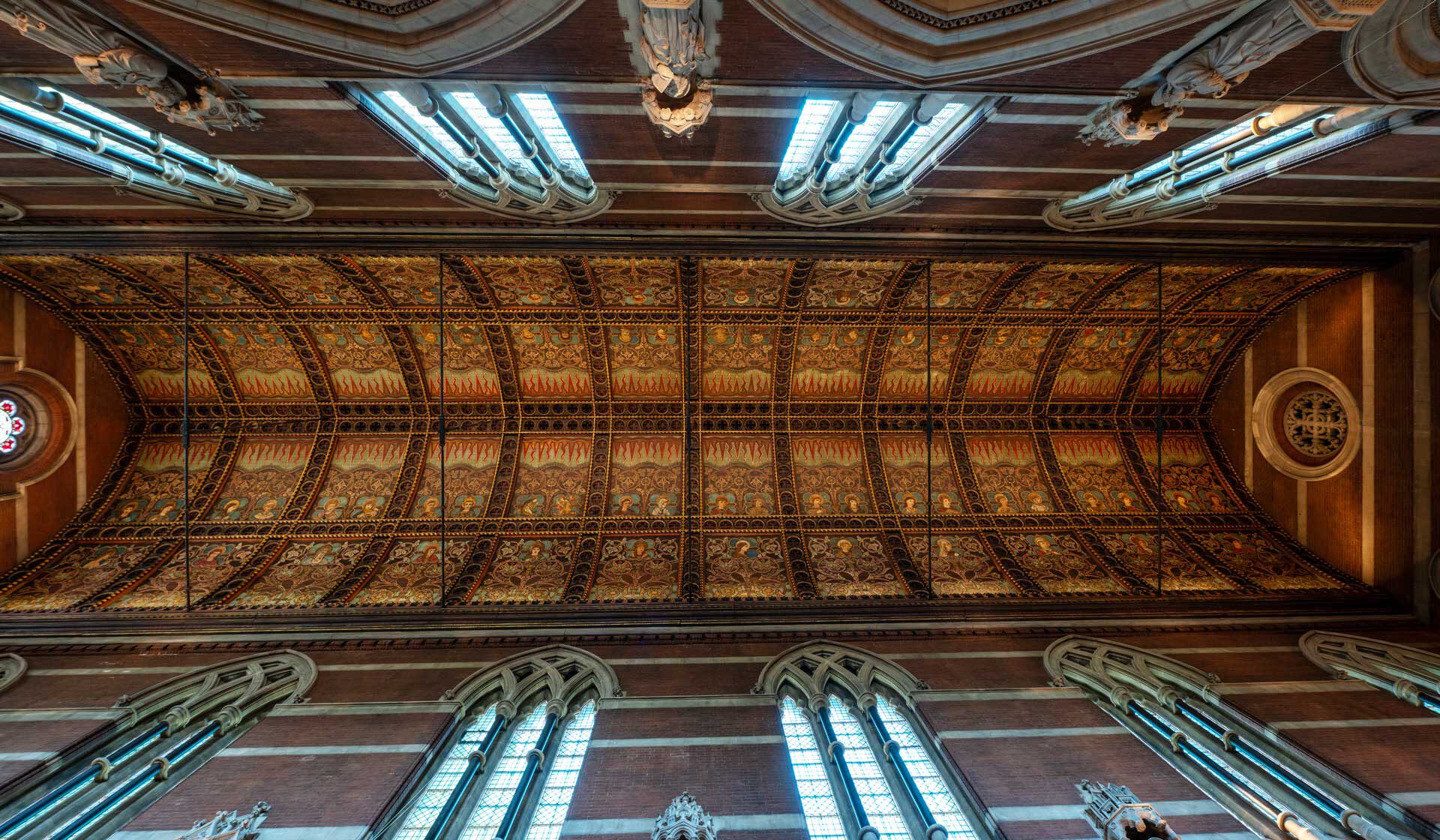
Look up, and you’ll see one of the church’s most extraordinary features: the painted nave ceiling, created by artist Daniel Bell (1840–1915). Known for his murals and stained glass in smaller London churches, Bell worked here with his brother Alfred, who is thought to have painted the chancel ceiling next door.

Before this, Bell had partnered with sculptor James Redfern, famed for Gothic Revival landmarks like the Albert Memorial. That dramatic, medieval influence shows in Bell’s breathtaking ceiling design: 72 saints and biblical figures arranged in twelve compartments, one for each month of the year, appearing in the month of their feast day.

The ceiling even mirrors Victorian church seating customs: men sat on the north side, women on the south, and the saints above follow the same division.

Bell painted the saintly faces on canvas and mounted them to the wooden ceiling, surrounding each with a dazzling background painted directly onto the boards. The flame-like shapes aren’t fire, they’re divine rays, symbolising holy light.

In 2018, after more than a century of candle smoke, incense, and London pollution, the ceiling was carefully cleaned by a team of twenty conservators over six months, revealing its vibrant colours once again.
Where is St Agnes?

Find the young woman with a lamb.

See how conservation cleaning brought St Agnes back into the light.

St Agnes was a young Roman martyr who died around the year 304 during the persecution of Christians under Emperor Diocletian. Known for her unwavering faith and purity, she is one of the most celebrated virgin martyrs of the early Church. According to tradition, she was only about 12 or 13 years old when she was executed for refusing to renounce her faith or marry a pagan nobleman. St Agnes is often depicted with a lamb, symbolising her innocence, and sometimes with a chalice as on our ceiling, representing her sacrificial death and connection to the Eucharist.

St Timothy’s Clean Up

Look for the figure holding a staff.

St Timothy was a close companion and disciple of St Paul, mentioned frequently in the New Testament. Born in Lystra to a Greek father and a Jewish Christian mother, Timothy became a trusted co-worker in Paul’s missionary journeys and is traditionally regarded as the first bishop of Ephesus. Paul’s two pastoral letters to Timothy offer insight into early Church leadership and Christian living. According to tradition, Timothy was martyred for denouncing pagan worship during a festival. Here he is depicted holding a staff, symbolising his role as a bishop and spiritual shepherd guiding the early Christian community.

St Jerome and His Hat

St Jerome was a major figure in early Christianity, best known for translating the Bible into Latin (the Vulgate), which became the standard version used by the Western Church for centuries. Born around 347 AD in present-day Croatia, he was a brilliant scholar and theologian often living in solitude near Bethlehem. Passionate and sometimes fiercely critical, Jerome devoted his life to Scripture and the defence of orthodox faith. He is often depicted wearing or accompanied by a cardinal’s hat, symbolising his role as a leading Church scholar, though the title itself didn’t exist in his lifetime.